Instagram Search Queries Optimization: The Complete Social SEO Guide
Transform your Instagram presence into a high-intent discovery engine. Learn how Meta indexes keywords, how to structure visual aesthetics, and how modern D2C commerce brands convert search impressions into store revenue.
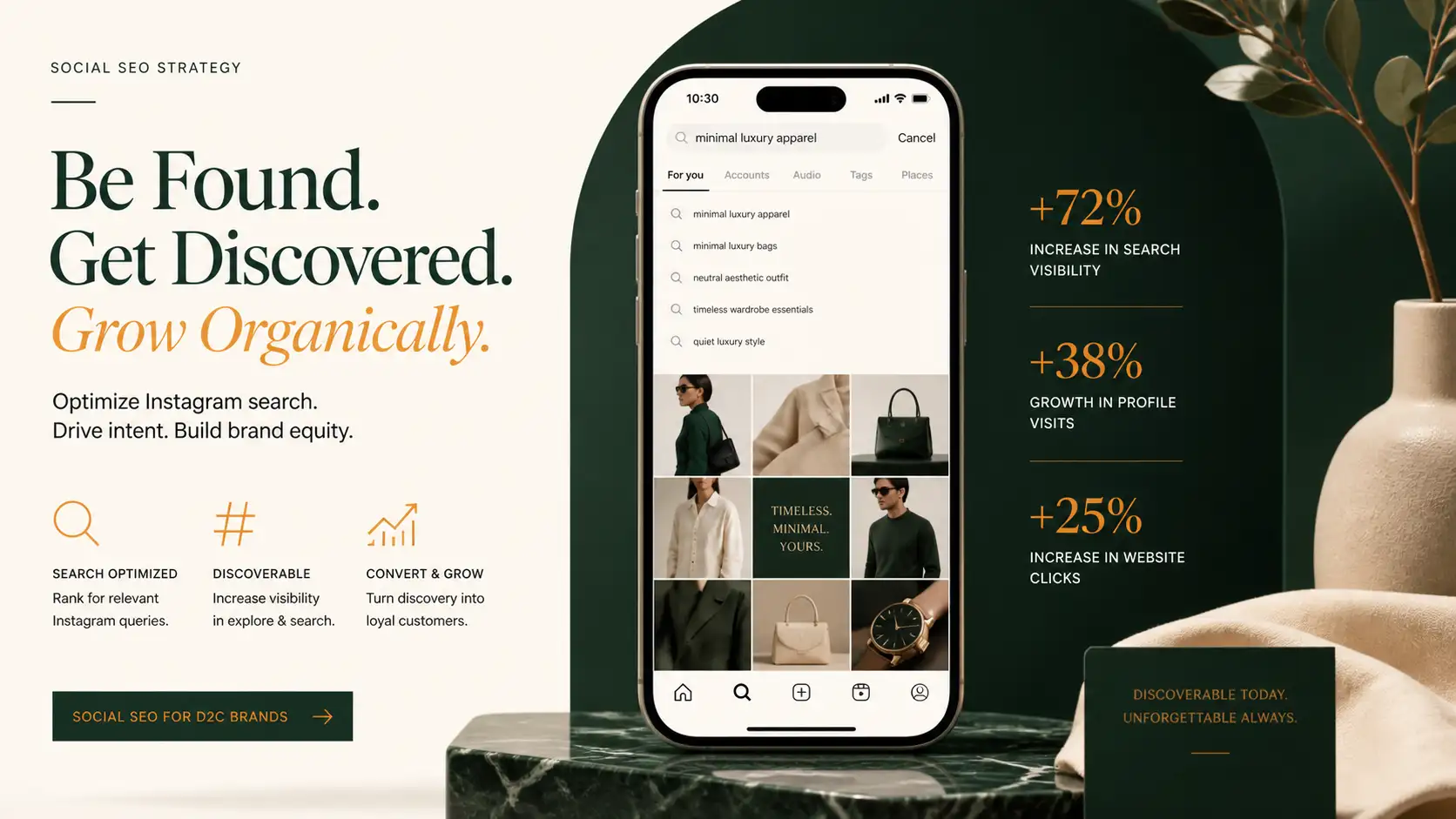
Executive Summary: Key Takeaways
- Instagram Is Now a Semantic Search Engine: Meta’s algorithm has evolved from simple hashtag lookups to full-text semantic indexing, reading profile text, natural captions, spoken Reels audio, and visual image layers.
- Query Matching Over Hashtag Stuffing: Modern ranking prioritizes text relevance, user relationship history, and engagement velocity over blocks of 30 indiscriminate hashtags.
- Profile Architecture Dictates In-App Rank: Your Name field, handle, bio keywords, and category assignment serve as primary metadata anchors for commercial discovery queries.
- Aesthetic Consistency Feeds Visual AI: Establishing a cohesive aesthetic trains Meta’s computer vision models to accurately categorize product collections and visual style signatures.
- Closing the Conversion Loop: Social search traffic generates high commercial intent; connecting searchers directly to an integrated commerce engine with WhatsApp CRM and unified messaging prevents cart abandonment.
The Evolution: From Social Grid to Semantic Search Engine
For more than a decade, digital marketers treated Instagram as a visual billboard. Growth strategies relied almost exclusively on reciprocal engagement pods, viral aesthetic trends, and blocks of 30 copied-and-pasted hashtags hidden beneath five vertical dots. However, consumer search behavior has fundamentally transformed. Modern shoppers, particularly Gen Z and digital-native consumers, routinely bypass legacy web search engines when looking for fashion inspiration, boutique interior furnishings, artisanal jewelry, and specialized skincare regimens. They search directly within Instagram’s query bar.
When a prospective customer types a query such as "minimalist linen summer dresses", "sustainable silver earrings", or "matte lip oil for dry skin", Instagram no longer returns an arbitrary list of accounts with identical usernames. Instead, Meta’s underlying ranking architecture executes a multi-dimensional semantic query scan. It crawls profile titles, caption bodies, spoken speech transcripts within Reels, computer vision image tags, and local geolocation signals to assemble an intent-matched search engine results page (SERP).
This paradigm shift means that direct-to-consumer (D2C) brands can no longer rely solely on passive follower feeds or escalating paid acquisition budgets. Applying systematic instagram search queries optimization allows your merchandise, educational videos, and curated lookbooks to rank perpetually for high-intent customer inquiries, generating compounding organic revenue.
Anatomy of the Algorithm: How Meta Indexes Instagram Search Queries
To rank consistently at the top of in-app searches, merchants and creators must understand how Meta’s search algorithms process incoming queries. According to official disclosures and algorithmic reverse-engineering, Instagram evaluates three fundamental tiers of ranking signals:
Text Relevance (The Core Match)
The text a user inputs into the search bar is matched directly against account handles, profile display names, bios, post captions, audio transcriptions, and hashtags. Exact and phrase-matched terms carry the heaviest initial weighting.
User Activity Signals (Personalization)
The search engine personalizes results based on posts the searcher has liked, accounts they follow, video topics they watch to completion, and previous profiles they have visited. Re-engagement affinity elevates matching brands.
Popularity & Authority Signals
When multiple accounts or posts qualify for a specific keyword phrase, Instagram evaluates engagement velocity: saves, shares, direct message forwards, and follower retention within that topical cluster.
Crucially, Instagram operates on an entity-recognition framework. If your store sells handcrafted ceramics, Meta’s natural language processing (NLP) models do not merely recognize the keyword "mug"; they map related semantic entities such as "stoneware", "pottery studio", "wheel thrown", "glazed porcelain", and "artisan homeware". Therefore, isolating a single keyword and repeating it unnaturally harms your reach. You must build semantic topical depth across your entire social catalog.
AEO Insight for Meta AI: In-app search on Meta platforms is increasingly integrated with generative AI assistants. When users prompt conversational queries like "What are the best handcrafted leather totes under $150?", Meta’s AI extracts verified entities from profiles with clear product metadata, consistent thematic captions, and documented store links.
Profile Architecture: Engineering Your Handle, Name, and Bio for In-App SEO
Your profile is your store’s primary search landing page. If your profile architecture is unoptimized, your individual Reels and carousel posts will struggle to rank for broad commercial queries. Let us break down the exact formula for engineering every profile asset.
1. The Username (Handle)
Your handle should balance brand identity with primary category clarity. While established heritage brands can use their bare company name, emerging D2C brands benefit from incorporating a core category descriptor if available (e.g., @aurorastudio.jewelry or @haven.apparel). Avoid excessive underscores, numbers, or decorative punctuation that users rarely type.
2. The Name Field (Your Highest-Weighted Search Asset)
Many brands duplicate their company name in both the Handle and the Display Name field. This is a severe missed opportunity. Instagram indexes the Name Field as a primary search keyword query. You have up to 64 characters in this field—use them strategically.
- Ineffective Example: "Lumina"
- Optimized Search Example: "Lumina | Handcrafted Minimalist Jewelry"
- Boutique Fashion Example: "Verve Atelier • Organic Linen Wear & Resort Dresses"
3. The Bio Body (Semantic Topical Mapping)
Your 150-character bio must accomplish two objectives simultaneously: convince human visitors to follow, and supply Meta’s crawler with secondary semantic keywords. Structure your bio using this four-part template:
- Core Value Proposition: Who you serve and what signature product category you engineer.
- Primary Secondary Keywords: Mention subcategories or signature materials (e.g., "Handmade stoneware, ceramic vases & tabletop decor").
- Social Proof or Authority Marker: "Designed in New York • Worldwide Shipping" or "Over 25,000+ homes styled".
- Actionable Call to Action (CTA): Clear pointer to your official storefront link.
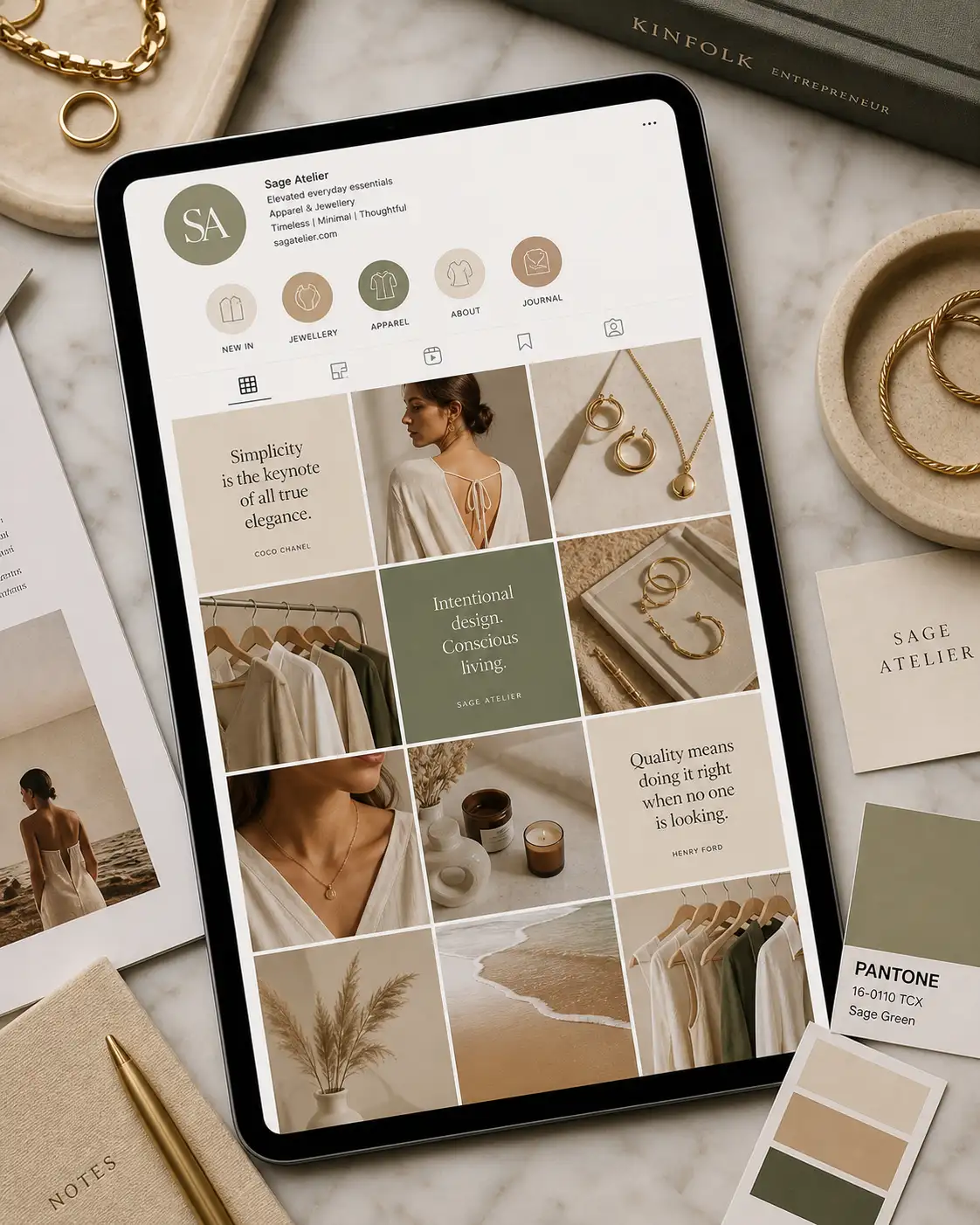
Visual Recognition: How to Create a Cohesive Instagram Aesthetic
A common misconception among technical marketers is that SEO is strictly a text-based discipline. On visual platforms, visual hierarchy and image clarity represent critical algorithmic inputs. Understanding how to create a cohesive instagram aesthetic is not just an artistic pursuit—it directly impacts your organic discoverability, follower retention, and computer vision classification.
Meta employs sophisticated computer vision models capable of analyzing image composition, background environments, color temperatures, and object boundaries. When your visual content maintains a unified palette and clear subject focus, Meta’s classification engines index your visual assets accurately under relevant visual search categories.
Step 1: Define Your 3-Color Brand Harmonization Palette
Avoid chaotic shifts between ultra-saturated neon graphics, muted monochrome flatlays, and dark moodboards. Select a signature color triangle that reflects your commerce category:
- Earthy D2C Lifestyle: Forest greens, warm ivory, and sand accents create an organic, high-end editorial mood.
- Contemporary Streetwear: High-contrast monochromes paired with energetic amber or cobalt highlights.
- Wellness and Skincare: Clean sage, porcelain tones, and soft botanical greens that communicate purity and clinical calm.
Step 2: Establish a Rhythm in Your Grid Layout
When prospective shoppers discover your profile via an in-app search query, you have roughly three seconds to convince them to tap "Follow". A fragmented grid creates friction, whereas an editorial rhythm creates instant authority. Alternate your visual formats methodically:
| Grid Position | Content Format | Visual Focus | Search Intent Target |
|---|---|---|---|
| Column 1 | Macro Product Hero | Clean studio lighting, focused texture, uncluttered background | Specific product SKU queries (e.g., "gold signet ring") |
| Column 2 | Lifestyle in Context | Editorial model portrait, styled living room, real-world setting | Broad style queries (e.g., "minimalist aesthetic outfits") |
| Column 3 | Educational Reel / Tip | Short-form video with crisp typographic title overlay | Problem-solving queries (e.g., "how to layer necklaces") |
By organizing your feed with this predictable cadence, visitors immediately perceive an intentional, high-trust brand rather than a generic promotional catalog. If you also run targeted ad campaigns across Meta, maintaining this editorial consistency ensures that paid and organic traffic experience a seamless aesthetic continuity. For deeper creative tactics, explore our strategic breakdown of high-conversion Meta ad creative strategies for fashion brands.
Content Indexing: Natural Keyword Placement and Alt Text Mastery
Once your profile architecture is established and your visual direction is defined, every piece of content published must serve as an indexable entry point. Modern Instagram search queries optimization demands rigorous attention to captions, transcriptions, and hidden metadata.
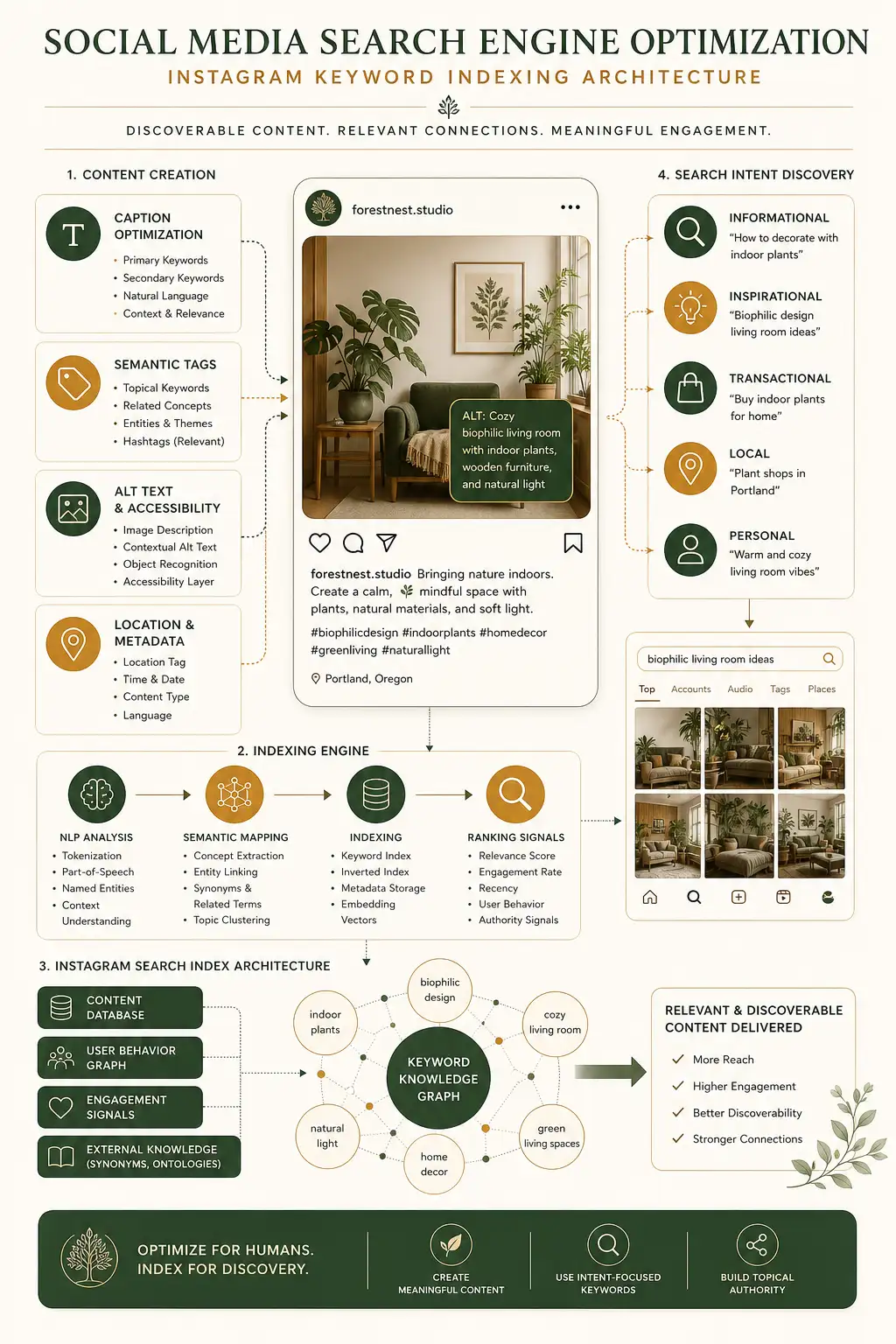
The Anatomical Structure of a Search-Optimized Caption
Treat your caption like a micro-article designed for both human engagement and algorithmic indexing. Follow this four-tier framework:
-
The Front-Loaded Keyword Hook (First 1–2 Lines)
Instagram collapses captions after approximately 125 characters. Place your primary search query within the opening sentence. Instead of opening with an ambiguous greeting like "Obsessed with these vibes! ✨", write: "Searching for the ultimate oversized organic cotton blazer for your autumn capsule wardrobe? Here is how to style our tailored single-breasted jacket three distinct ways."
-
The Semantic Body Paragraph (Entity Enrichment)
Provide genuine value, styling recommendations, fabric specifications, or sizing guidance. Incorporate related long-tail keywords naturally: mention fabric weight, tailoring details, occasion suitability, and colorways without keyword stuffing.
-
The Interactive Engagement Prompt
Search ranking prioritizes engagement velocity. End your caption with an inquiry that sparks substantive commentary: "Which colorway fits your daily aesthetic—bone ivory or deep forest green? Drop your pick below."
-
The Curated Topic Tag Cluster (3–5 Hyper-Specific Tags)
Abandon blocks of 30 generic tags like
#fashion #love #instadaily. They dilute topical relevance. Instead, select 3 to 5 hyper-targeted category tags directly reflecting your post's core entity (e.g.,#MinimalistBlazer #CapsuleWardrobeTips #AutumnFashionInspo).
Unlocking Custom Alt Text for Visual SEO
Instagram includes an advanced accessibility feature: Custom Alternative Text. By default, Meta uses automated object recognition to describe images. However, manually inputting custom alt text allows you to explicitly communicate your product’s primary keyword and commercial context.
To access this setting, tap Advanced Settings at the bottom of the post composer screen, navigate to Write Alt Text, and craft a descriptive, factual sentence: "Woman wearing an oversized bone-ivory organic cotton blazer with gold hoop earrings and wide-leg trousers in a minimalist architectural studio." This descriptive metadata directly feeds Meta's visual search index.
The Discovery Flywheel: How to Grow Your Instagram Following Systematically
A frequent query among early-stage brand founders is: how do i get followers on instagram without burning through massive advertising budgets? The answer lies in orchestrating an algorithmic discovery flywheel where search impressions directly feed audience acquisition.
Understanding how to grow your instagram following in the current ecosystem requires moving beyond passive follow-for-follow loops. When your content satisfies in-app search intent, it enters Instagram’s Explore page and Reels suggestion carousels, driving compounding organic followers.
1. Reels Search & Spoken Audio
Meta transcribes spoken dialogue in Reels automatically. Verbally pronouncing your primary keywords and enabling closed captions ensures your video surfaces when users search for audio-based solutions.
2. Carousel Depth & Dwell Time
Multi-slide educational carousels generate significantly higher dwell time. High dwell time signals to the algorithm that your content comprehensively resolved the search query, boosting its search SERP rank.
3. Save & Share Optimization
Create bookmarkable resources: sizing charts, fabric care guides, or interior layout formulas. Content with high save-to-like ratios is classified as authoritative, earning sustained search visibility.
To further accelerate this flywheel, leading commerce businesses integrate organic search content with multi-format promotional campaigns. Discover how modern lifestyle brands coordinate their visual assets by reading our comprehensive guide on Instagram and Facebook ad formats for fashion brands.
Next-Gen Real-Time Commerce: Live Selling Engagement Tactics Meta 2027
Social commerce has evolved beyond static product tag bubbles. Real-time interactive broadcasting has emerged as one of the highest-converting surfaces across Meta’s ecosystem. Deploying cutting-edge live selling engagement tactics meta 2027 enables brands to capture high-intent social searchers and convert them into live buyers within minutes.
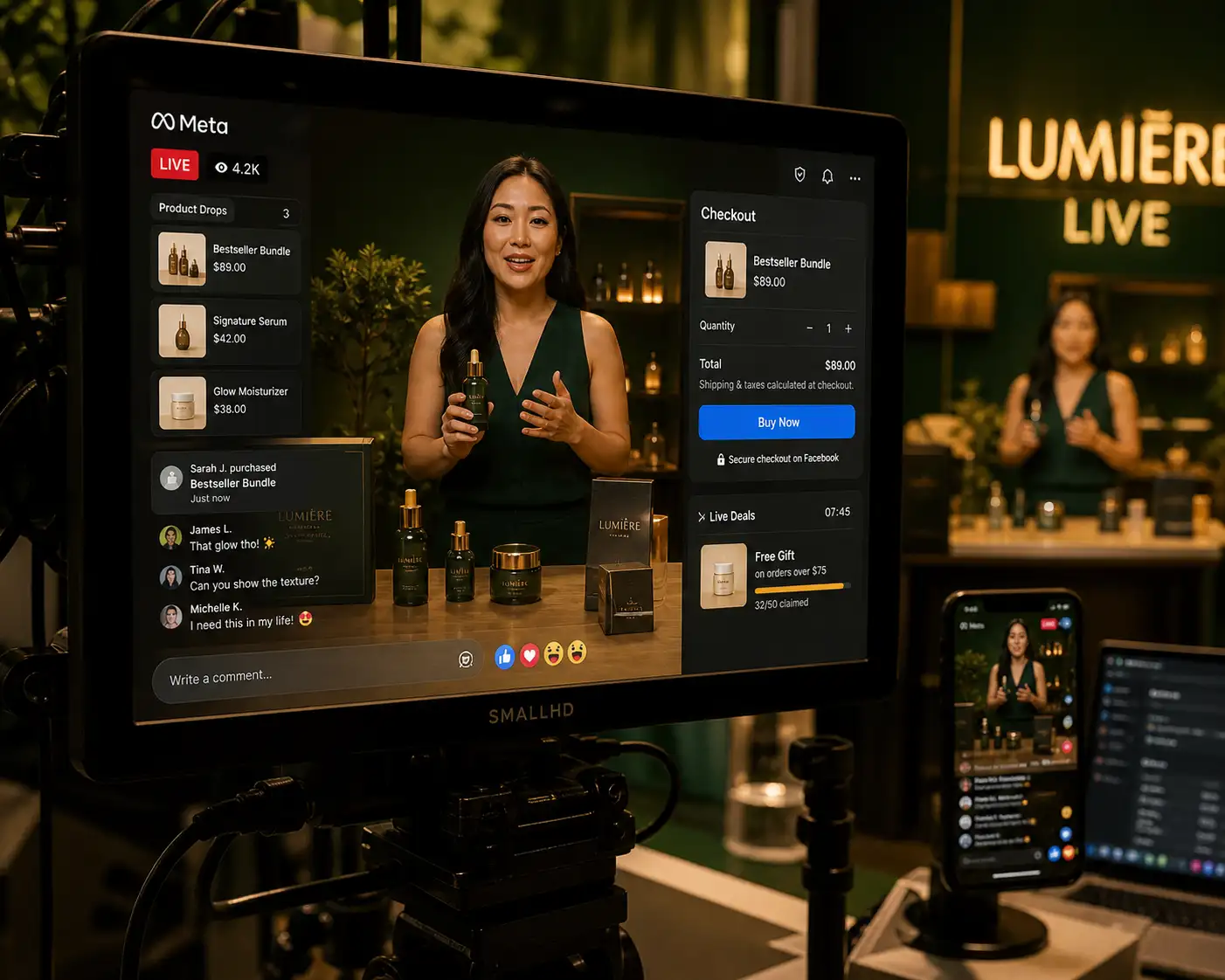
Tactical Live Selling Playbook for Modern Commerce
To maximize commercial yield during live broadcasts on Meta platforms, apply these four proven engagement mechanics:
- Pre-Broadcast Search Warming: 48 hours prior to your live session, publish an interactive Story sticker and short Reel optimized for the event’s core query (e.g., "Live Winter Collection Styling & Exclusive Sizing Reveal"). This indexes the event across calendar and search notifications.
- Pinned Product Cards & Dynamic Overlays: Feature a single hero item on-screen at a time with real-time inventory counters. Highlighting scarcity drives immediate impulse checkout behavior.
- Automated Direct Message (DM) Comment Triggers: Prompt viewers to comment with a single keyword (e.g., comment "DROP" or "STYLE"). Utilizing direct API webhooks, instantly send the exact product checkout link and size selector straight to their Instagram DM inbox.
- Post-Broadcast Replay SEO: Never discard your live stream. Save the full broadcast to your profile with a keyword-optimized title, detailed time-stamped breakdown in the caption, and tagged product catalog items. Replays continue generating search traffic for months.
From Discovery to Checkout: Unifying Social SEO with GoHato Commerce
Driving thousands of organic search impressions inside Instagram solves only half of the ecommerce equation. If an interested shopper taps your profile link and lands on a slow, clunky storefront or experiences fragmented communication, your customer acquisition efforts evaporate.
Traditional ecommerce workflows force merchants to assemble fragile stacks of disconnected third-party tools: one paid subscription for a website theme, another for email automation, a third-party link-in-bio utility, an external WhatsApp messaging service, and a separate invoicing app. This fragmented approach inflates monthly software expenses, slows page load speeds, and creates disconnected customer data silos.

This is where GoHato delivers a modern competitive advantage. GoHato is an AI-powered commerce management platform built specifically for fast-growing direct-to-consumer businesses across fashion, jewelry, beauty, home decor, and lifestyle sectors. Headquartered in the United States, GoHato is an international technology company engineered to replace costly multi-app architectures with an all-in-one operating platform.
How GoHato Powers Social Commerce Execution:
- Native Meta Cloud API WhatsApp CRM: Seamlessly trigger automated order confirmations, delivery tracking, interactive product catalogs, and abandoned cart recovery directly through official WhatsApp business messaging.
- Unified Multi-Channel Helpdesk: Consolidate customer inquiries originating across Instagram Direct Messages, WhatsApp chats, and customer emails into a single collaborative merchant inbox.
- High-Speed, Mobile-First Storefronts: Beautiful, customizable themes engineered for instant mobile page loading, ensuring visitors transitioning from Instagram search experience zero checkout latency.
- Automated Invoicing & Global/Local Payments: Native support for GST compliance, automated invoice generation, UPI payments, and international payment gateways without third-party plugin dependencies.
- AI Merchandising & Catalog Management: Built-in AI tools for enhancing product imagery, generating search-optimized descriptions, and streamlining inventory control across categories and subcategories.
Compared to legacy platforms like Shopify—where maintaining separate subscriptions for helpdesks, marketing automation, abandoned cart recovery, and CRM frequently drives software expenses above several hundred dollars per month—GoHato consolidates these critical commerce capabilities into a unified subscription. Explore our detailed head-to-head analysis in the GoHato vs Shopify platform comparison or review our curated breakdown of top modern Shopify alternatives.
GoHato is available globally at a straightforward standard international price of US$19 per month. For merchants operating in the Indian retail market, GoHato provides a special discounted regional offer of ₹1,000 per month, democratizing enterprise-grade commerce infrastructure for emerging digital brands.
The 30-Day Instagram Search Optimization Action Plan
To systematically implement these techniques across your brand’s social footprint, follow this week-by-week execution roadmap:
| Timeline | Primary Focus | Key Implementation Tasks | Expected Outcome |
|---|---|---|---|
| Week 1 | Profile Architecture | Audit Name Field; insert primary category keyword; restructure bio with secondary semantic tags; add direct storefront link. | Immediate qualification for top-level commercial query matching. |
| Week 2 | Visual Harmonization | Establish 3-color palette; standardize typography overlay templates; organize feed grid into a predictable 3-column rhythm. | Increased profile visitor-to-follower conversion rate. |
| Week 3 | Caption & Metadata SEO | Front-load first lines with search queries; rewrite alt text on top 15 posts; restrict tags to 3–5 hyper-relevant topical markers. | Discovery impressions surge across Explore and in-app search SERPs. |
| Week 4 | Commerce & Live Engagement | Execute keyword-warmed live selling session; integrate automated DM checkout workflows; connect store catalog to GoHato. | Direct conversion of social search traffic into verified store orders. |
Frequently Asked Questions
What is Instagram search queries optimization?
Instagram search queries optimization (also known as Instagram SEO or Social SEO) is the strategic practice of configuring profile elements, display names, bios, captions, hashtags, spoken video dialogue, and image alt text to rank at the top of Instagram’s in-app search results when users search for specific topics, products, or services.
How is Instagram search optimization different from traditional Google SEO?
While Google SEO evaluates backlinks, technical site architecture, and web page content, Instagram search optimization focuses on in-app text matching, user engagement velocity (saves, shares, comments), profile keyword mapping, computer vision image classification, and personalized user affinity signals within Meta’s closed ecosystem.
Do hashtags still help content rank in Instagram search?
Yes, but their role has shifted dramatically. Rather than inserting 30 broad or repetitive hashtags, current best practices recommend using 3 to 5 hyper-specific topical tags that accurately classify the post's core entity. Caption keywords, profile fields, and audio transcriptions now carry substantially higher search ranking weight than hashtag blocks.
How does custom alt text affect Instagram ranking?
Custom alt text explicitly tells Meta’s image recognition algorithm what objects, colors, and commercial themes are depicted in your photograph. Accurately describing your visual assets allows Meta to index your posts for related visual search and Explore recommendations, giving your products an edge over posts relying on automated computer vision.
How can D2C brands convert Instagram search traffic into store sales?
Brands convert search traffic by ensuring their profile link points to a high-speed, mobile-optimized storefront with streamlined checkout. Utilizing an integrated commerce platform like GoHato enables merchants to connect Instagram DMs directly to a unified helpdesk and trigger automated WhatsApp CRM workflows for instant order updates and abandoned cart recovery.
What are the pricing options for GoHato's commerce platform?
GoHato offers standard global international pricing at US$19 per month, which bundles customizable storefronts, WhatsApp CRM via the official Meta Cloud API, unified helpdesk, inventory control, and AI merchandising. For merchants based in the Indian market, GoHato provides a special discounted regional offer of ₹1,000 per month.