High Conversion Meta Ad Creative Strategies for Handbags Fashion 2027
The definitive playbook for modern luxury leather goods, vegan tote labels, and designer handbag houses scaling paid customer acquisition through sensory visual hooks, catalog fixes, and server-side conversion architecture.

- Creative is the New Targeting: With Meta Andromeda and Advantage+ algorithms fully automating audience segmentation, ad creative is the single decisive variable determining customer acquisition cost (CAC) and return on ad spend (ROAS).
- Tactile Sensory Video Dominance: Static flat-lays fail to convert cold traffic; 2027 winning ad sets rely on 15-second macro-texture zooms, zipper glide acoustics (ASMR), and comprehensive "What Fits Inside My Bag" spatial demonstrations.
- Cross-Vertical Creative Borrowing: Forward-thinking handbag labels are outperforming legacy players by borrowing formulas directly from meta ads library beauty brand trends 2027, specifically swatch comparisons, morning routine pacing, and micro-influencer texture closeups.
- Automated Catalog Resuscitation: Traditional white-background Advantage+ catalog ads generate dismal conversion rates; implementing dynamic lifestyle overlays, urgency badges, and custom product feeds resolves catalog drop-off instantly.
- Server-Side Conversion Integrity: High average order value (AOV) fashion purchases require resilient signal transmission via meta capi (Conversions API) to feed machine-learning models with deterministic purchase value data.
- Unified Storefront Continuity: High-performing ad creative collapses when routed to sluggish, disconnected storefronts. Native commerce stacks with integrated WhatsApp checkout recovery transform impulse ad clicks into repeat brand advocates.
The 2027 Meta Handbag Advertising Paradigm: Algorithmic Reality
Direct-to-consumer (D2C) fashion brands operating in luxury accessories, designer leather goods, and premium travel luggage face an advertising climate radically transformed from previous cycles. In 2027, the days of granular demographic hacks, interest-stack exclusions, and manual lookalike layering on Meta Ads Manager have evaporated. Meta's Andromeda optimization engine and Advantage+ Shopping Campaigns (ASC) now operate as autonomous discovery engines.
Because the algorithm auto-expands audiences globally within milliseconds, your creative asset is no longer merely a message; your creative is your audience targeting mechanism. When your ad features a structured Italian pebbled leather tote opening to reveal laptop compartments, Meta scans the optical pixels, audio waveforms, captions, and user dwell velocity to match your creative with high-intent accessory buyers.
However, handbag customer acquisition carries distinct friction points compared with commoditized apparel:
- Substantial Average Order Value (AOV): With ticket sizes routinely ranging between $120 and $650 (or ₹9,000 to ₹45,000 in emerging luxury markets), customers rarely purchase on instant impulse from a single static impression.
- Tactile Uncertainty: Handbag consumers obsess over sensory validation—leather suppleness, hardware durability, lining resilience, and dimensional capacity. If an ad creative fails to convey tactile reality, hesitation halts checkout progression.
- Creative Fatigue Velocity: Because luxury and fashion audiences consume visual media rapidly, an identical creative angle experiences performance decay within 12 to 18 days of high-budget scaling.
To scale sustainably, fashion houses must execute a disciplined system of creative variation, borrowing structural frameworks from high-velocity ecommerce sectors and synchronizing ad delivery with resilient server-side data infrastructure.
The 5 Core Pillars of High-Converting Handbag Ad Creatives
Analyzing top-performing luxury accessories ad accounts across North America, Europe, and Asia reveals five non-negotiable creative archetypes. Brands deploying these formats systematically outpace competitors in click-through rates (CTR) and thumb-stop ratios.
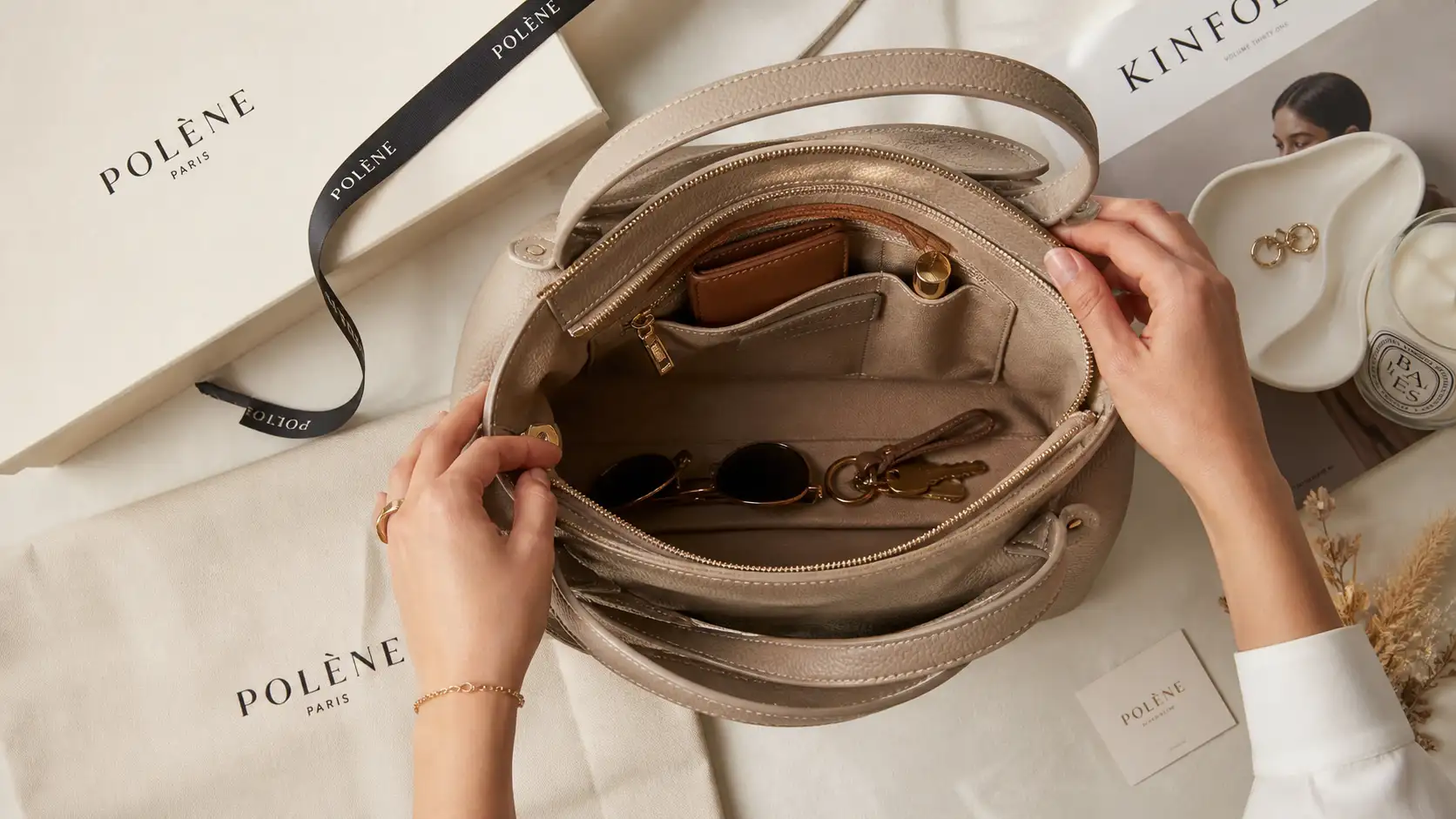
The Tactile ASMR Unboxing
Bypasses music-heavy stock clips to feature crisp natural audio: the slide of high-grade zippers, the snap of magnetic brass closures, and finger taps against grain leather. Delivers instant sensory credibility within the initial 3 seconds.
Spatial Utility ("What Fits")
A fast-paced, top-down packing sequence showing exactly how a structured satchel seamlessly accommodates a 14-inch MacBook, Kindle, cosmetic pouch, keys, and water bottle without losing its architectural silhouette.
The 3-Way Styling Transform
Demonstrates versatility by showcasing one handbag styled across three distinct daily scenarios: corporate boardroom morning, weekend brunch casual, and evening gala elegance with strap adjustments.
The Craftsmanship Breakdown
Micro-documentary cuts detailing edge-paint application, saddle-stitching durability, stress-testing handle rivets, and ethical material sourcing. Instills luxury prestige without pretentious jargon.
Editorial Still Lifes with Bold Hooks
High-contrast, studio-lit single-image ads featuring clean typography overlays stating a singular undeniable value proposition: "Engineered to replace three everyday bags" or "Handcrafted Tuscan leather under $200."
Founder Sourcing Narratives
The founder standing inside the tannery or atelier, candidly explaining why traditional luxury department stores markup identical leather goods by 10x, positioning your brand as the discerning direct insider choice.
Implementing these archetypes requires precise execution of video pacing. The first two seconds must contain zero introductory logo animations or slow fades. Instead, launch instantly with movement: an unbuckling strap, an open compartment revealing interior pockets, or an arresting side-by-side scale comparison against a model's torso.
To master structural pacing and ad asset technical constraints, fashion founders should consult our companion playbook on Instagram and Facebook ad formats for fashion brands, which covers optimal aspect ratios, Reels duration thresholds, and multi-placement export configurations.
Cross-Vertical Intelligence: Borrowing from Meta Ads Library Beauty Brand Trends
The most lucrative creative breakthroughs in fashion rarely originate within fashion circles. In modern digital advertising, the cosmetics, clinical skincare, and luxury fragrance verticals innovate creative formats roughly twelve months ahead of accessories. By conducting systematic competitive teardowns of the Meta Ads Library, performance directors can extract high-converting formulas and transplant them directly into handbag campaigns.
Beauty brands convert high-skepticism buyers by spotlighting clinical texture swabs, immediate shade matching, and unedited bathroom lighting. When handbag merchants apply these exact visual cues—replacing foundation swatches with edge-burnish tests and scratch-resistance demonstrations—conversion lift averages 28% to 42%.
Studying meta ads library beauty brand trends 2027 reveals three dominant tactical blueprints ready for immediate adaptation:
1. The "Texture Swatch" Macro Camera Close-Up
Skincare leaders convert consumers by showing thick creams emulsifying on skin pores under 4K macro lenses. In luxury handbags, replace this with extreme macro video pans of full-grain leather graining, hand-waxed thread tensile tests, or water droplet repellency on vegetable-tanned surfaces. This micro-visual proves material authenticity far more effectively than a generic studio lifestyle portrait.
2. Split-Screen "Before & After" / "Wear & Tear" Stress Tests
A classic beauty format contrasts dull skin on the left with hydrated radiance on the right after 14 days. Handbag brands frequently fear showing anything less than pristine studio perfection. However, elite DTC labels win by featuring "Day 1 vs. Day 730" split-screen reels, illustrating how rich patina develops over two years of daily commutes while structural seams remain completely intact.
3. The "Unready With Me" Routine Integration
Rather than polished commercial shoots, observing meta ads library beauty brand trends demonstrates the sheer volume of organic, front-facing camera lifestyle sequences. Handbag creatives convert exceptionally well when integrated into the creator's daily ritual: unzipping the tote upon arriving at a boutique hotel, transferring essentials between evening clutches, and commenting candidly on how comfortable the shoulder strap feels after eight hours of airport walking.
| Beauty Ad Format Benchmark | Handbag Fashion Equivalent Adaptation | Primary Buyer Barrier Resolved | Typical 2027 Benchmark ROAS |
|---|---|---|---|
| Foundation Shade Swatch on Wrist | Leather Swatch vs. Everyday Wardrobe Palette | "Will this tone match my seasonal coats?" | 3.4x – 4.2x |
| Waterproof Mascara Smudge Test | Keys Scratched Against Scratch-Proof Saffiano | "Will my expensive bag ruin within a month?" | 3.8x – 5.1x |
| 7-Day Clinical Hydration Trial | 365-Day Daily Commute Patina Evolution | "Is the leather genuine and durable?" | 2.9x – 3.7x |
| GRWM: Packing the Beauty Bag | What Fits Inside: Laptop, Gym Wear & Essentials | "Is it spacious enough for real everyday life?" | 4.1x – 5.6x |
Fixing Low ROAS: Meta Catalogue Ads Low Conversion Rate Fix Strategies
Advantage+ catalog ads (formerly dynamic product ads or DPA) represent the backbone of bottom-of-funnel retargeting and broad algorithmic discovery. Yet, accessory merchants routinely experience abysmal conversion rates from these automated formats, suffering from high cost-per-click and immediate bounce rates.
The culprit is straightforward: default catalog feeds pull sterile, stark-white packshots designed for enterprise ERP systems rather than mobile-first social feeds. When an Instagram user scrolling through vibrant editorial imagery encounters an isolated white silhouette of an empty satchel, it looks like a generic wholesaler listing, instantly killing emotional desire.
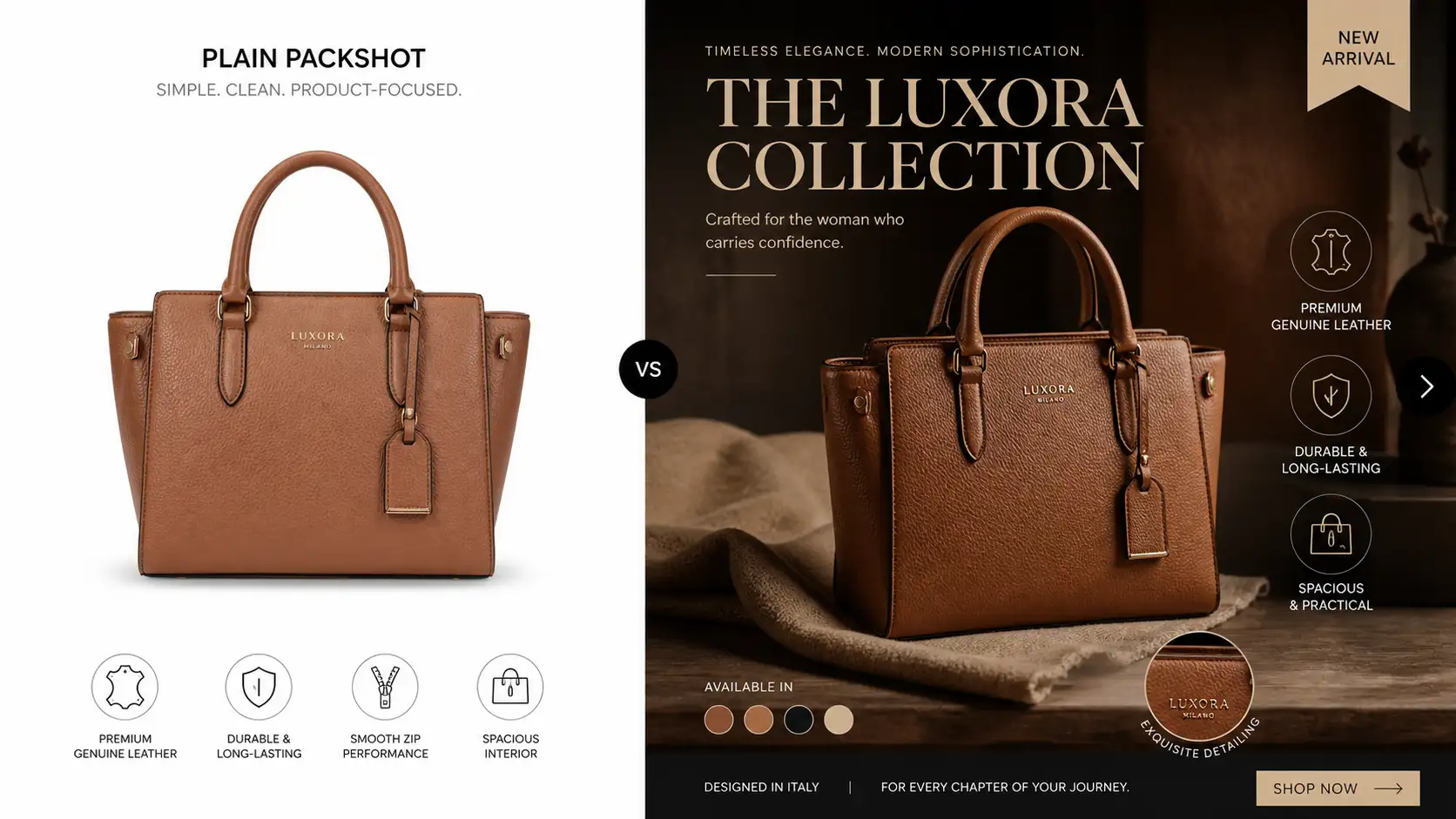
To resurrect automated catalog profitability, implement these proven meta catalogue ads low conversion rate fix strategies across your product catalog architecture:
- Isolated white background packshots with zero scale context.
- Default title tags displaying confusing internal SKU names.
- No secondary image cards showing interior pocket organization.
- Static price tags without local currency clarity or payment badges.
- Out-of-stock variations left active in feeds, burning ad spend on dead clicks.
- Dynamic 1:1 lifestyle overlays showing model holding bag to scale.
- Smart category framing: "Fits 15-inch Laptops" pill badges.
- Multi-image carousel cards showcasing exterior and interior compartments.
- Colorway swatches rendered directly on the bottom edge of the card.
- Automated inventory synchronization cutting off out-of-stock colorways instantly.
Step-by-Step Execution of Catalog Creative Overlays
-
Inject Multi-Angle Secondary Imagery into Meta Commerce Manager
Ensure your commerce catalog feed does not terminate on a single primary image. Configure catalog templates to display image index [1] (lifestyle model in motion) or [2] (open top-down interior layout) when users swipe carousel cards.
-
Implement Dynamic Badge Overlays for Social Proof
Using Meta's creative tools or automated feed managers, map custom product attributes to visual badges. Highlight attributes like "Full Grain Vachetta", "Rated 4.9/5 by 1,200+ Professionals", or "Complimentary Express Monogramming" directly across the image canvas.
-
Segment Catalogs by AOV and Usage Intent
Never dump evening clutches, everyday work totes, and luggage duffels into one catch-all catalog campaign. Split product sets into functional tiers: Professional Workbags ($250–$450), Travel Accessories ($80–$180), and Weekend Mini-Bags ($120–$220). This allows your dynamic ad copy to speak specifically to the exact functional utility of that category.
The Full-Funnel Creative Matrix: Cold Discovery to Retargeting
High-ticket accessories require deliberate visual sequencing. A prospective customer discovering your label on an Instagram Reel requires sensory inspiration and emotional desire; a return visitor who abandoned their cart at 11:30 PM requires risk reversal, warranty reassurance, and frictionless payment options.
| Funnel Stage | Primary Creative Hook | Visual Execution Format | Dominant Psychological Trigger | Target Metric Target |
|---|---|---|---|---|
| Top of Funnel (TOF) Broad Cold Prospecting |
"The only workbag that doesn't collapse when you put your laptop inside." | 9:16 Vertical Reel, ASMR unboxing, 3-way styling transition. | Curiosity, status elevation, problem recognition. | Hook Rate > 38% Outbound CTR > 1.8% |
| Middle of Funnel (MOF) Engaged Browsers (30-Day) |
"What actually fits inside? A real day in the life of our structured satchel." | 4:5 Carousel, side-by-side colorway comparison, leather durability tests. | Sensory validation, functional certainty, craftsmanship proof. | Add-to-Cart Rate > 8.5% Cost Per ATC < $18 |
| Bottom of Funnel (BOF) Cart & Checkout Abandoners |
"Still deciding on Olive Green? Enjoy complimentary lifetime edge repair & seamless 30-day exchanges." | Enriched Catalog Carousel + Founder reassurance video still. | Risk elimination, loss aversion, purchase urgency. | Purchase Conversion Rate > 4.2% ROAS > 5.5x |
Notice the deliberate shift in messaging. Cold ad creatives must never plead for an immediate sale with desperate discount codes. Slashing 20% off on first impression erodes luxury brand equity. Instead, reserve promotional offers or complimentary gift packaging exclusively for dynamic retargeting audiences who have expressed high intent but stalled at shipping calculation steps.
Server-Side Data Hygiene: Why Meta CAPI is Mandatory for Luxury Fashion
Even the most breathtaking creative concepts collapse if your attribution pipeline suffers from blind spots. In 2027, browser-based Meta Pixel tracking misses anywhere between 25% and 40% of conversion events due to mobile operating system privacy controls, ad blockers, Safari ITP cookie expirations, and cross-device customer paths.
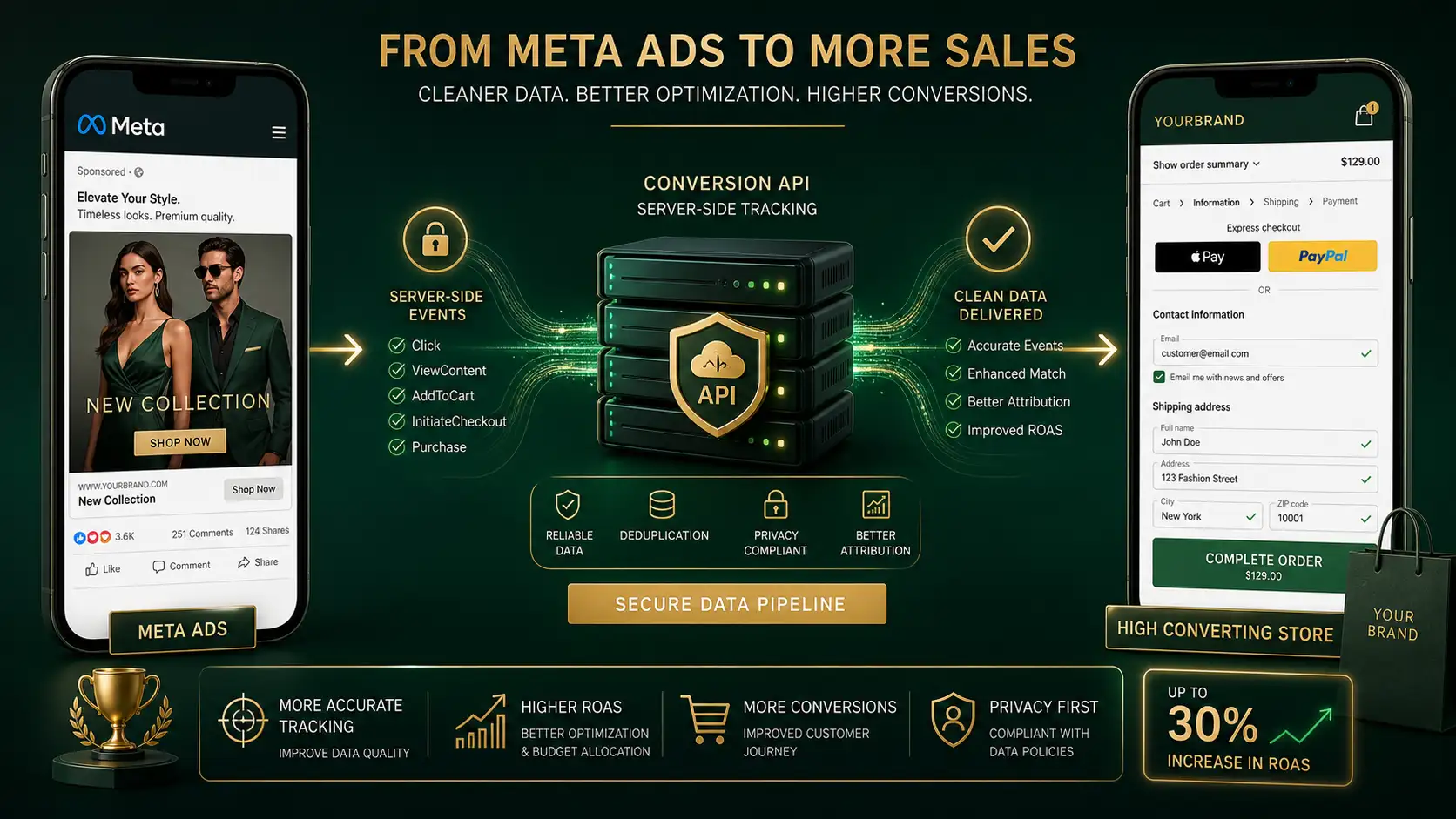
This is where meta capi (Conversions API) becomes an indispensable operational requirement for fashion merchants. Rather than relying on client-side browser execution, Conversions API establishes a secure, direct server-to-server connection between your ecommerce storefront backend and Meta's advertising servers.
When Meta receives real-time, deterministic server-side purchase signals matched with hashed customer identifiers (email, telephone, city, postal code), Meta's Event Quality Match Score (EMQ) surges from a mediocre 4.5/10 to an elite 8.8/10 or higher. This precision allows Advantage+ bidding algorithms to seek out actual high-AOV buyers rather than casual window-shoppers.
Essential Event Deduplication and Matching Parameters
To implement meta capi correctly without skewing campaign analytics, fashion brands must enforce strict technical standards:
- Event Deduplication: Every server event and browser event must transmit identical
event_idandevent_namepairs (e.g.,Purchase_10842). Meta's ingestion pipeline processes the first event received and discards the duplicate, preventing double-reported revenue figures. - Deep Customer Information Parameters (CIP): Transmit normalized, SHA-256 hashed customer parameters including
em(email),ph(phone in E.164 international format),fn(first name),ln(last name),ct(city), andzp(zip/postal code). - Custom Currency and Basket Value Data: High-ticket handbag brands selling internationally must explicitly pass currency ISO codes (
USD,EUR,INR,GBP) alongside accurate line-item product IDs to ensure ROAS reflects genuine net gross merchandise value.
Many legacy ecommerce setups require expensive third-party tracking middleware or fragile custom tag manager containers that constantly break during platform updates. Choosing a unified modern commerce infrastructure with native, built-in server-side Conversions API integration eliminates these vulnerabilities instantly.
The 14-Day Creative Sprint: Testing Angles Without Budget Drain
High-growth fashion brands do not gamble budgets on creative assumptions. They implement rapid, hypothesis-driven creative testing sprints inside Meta Ads Manager. The objective is to identify winning creative hooks at minimal spend before migrating them into high-budget Advantage+ scaling campaigns.
The 3:2:2 Dynamic Creative Testing Architecture
The most cost-effective method for discovering breakout handbag winners is the 3:2:2 Dynamic Creative Testing (DCT) structure:
- 3 Visual Assets: Three distinct video or image executions testing radically different psychological angles (e.g., Asset A: Sensory ASMR Leather Close-up; Asset B: Spatial Laptop Utility; Asset C: Founder Atelier Sourcing Story).
- 2 Primary Texts: One short-form punchy hook (under 125 characters focused on aesthetic luxury) and one long-form editorial hook (250+ words breaking down material specifications and warranty reassurance).
- 2 Headlines: One focused on social validation ("Voted #1 Everyday Workbag of 2027") and one focused on risk reversal ("Free Shipping & 30-Day In-Home Trial").
Isolate your creative testing campaign with an explicit ad-set budget cap ($50 to $100 per day per DCT). Let the ad set run uninterrupted for a minimum of 5 to 7 days until it generates at least 50 outbound clicks or 3 to 5 purchases. Once Meta’s delivery algorithm allocates 70%+ of budget to a single creative permutation and maintains an above-target return, extract that winning post ID (dark post) and insert it as an active creative inside your broad Advantage+ Shopping scaling campaign.
Post-Click Conversion Continuity: Bridging Ad Creative to Cart
A fatal error made by fashion marketers is pouring tens of thousands of dollars into immaculate Meta ad creative, only to dump high-intent traffic onto a generic, slow-loading homepage or a cluttered, disorganized product detail page (PDP). When your ad promises a specific pebbled leather laptop tote in cognac brown, the destination page must echo that exact colorway, model imagery, and headline promise within the first screenful of pixels.
1. Speed and Mobile-First Sensory Layout
Over 92% of Meta ad traffic originates on mobile devices inside Instagram and Facebook in-app browsers. If your product page takes longer than 2.2 seconds to achieve Largest Contentful Paint (LCP), bounce rates spike past 58%. Modern fashion storefronts must deliver high-resolution zoom capabilities, smooth swatch toggling, and instant mobile checkout without laggy third-party app scripts bogging down performance.
2. WhatsApp Conversational Checkout and High-Intent Recovery
In global fashion commerce, particularly across international markets and rapid-growth regions, immediate conversational connection bridges the trust gap for high-AOV purchases. When prospective customers hesitate over leather care, strap sizing, or delivery timelines, offering one-click WhatsApp chat support directly from the product page converts hesitant shoppers into confirmed orders.
Furthermore, automated abandoned cart recovery via the official Meta Cloud API boasts an astounding 80%+ open rate and 25%+ recovery rate—far outperforming traditional email marketing alone. Automated COD verification workflows and immediate WhatsApp dispatch notifications simultaneously slash return-to-origin (RTO) rates for emerging market deliveries.
3. Unified Commerce Infrastructure vs. Fragmented App Stacks
Merchants scaling on legacy platforms like Shopify often find themselves trapped in a maze of 15 to 25 disparate third-party plugin subscriptions—one paid app for WhatsApp CRM, another for product reviews, another for currency conversion, another for inventory sync, and another for server-side CAPI tracking. This bloated setup not only inflates operational software costs to $300–$800+ monthly but also creates code conflicts that degrade site speed and break conversion tracking.
For a detailed breakdown of total cost of ownership, migration timelines, and built-in commerce workflows, review our comprehensive analysis of GoHato vs Shopify platform comparison.
GoHato is an AI-powered commerce technology company headquartered in the United States, engineered specifically to eliminate fragmented third-party app dependencies for modern D2C fashion, jewellery, and lifestyle brands globally. With standard international pricing at just US$19 per month (and a special discounted offer of ₹1,000 per month for the Indian market), GoHato provides luxury fashion merchants with high-converting storefront themes, native Meta Conversions API tracking, automated WhatsApp CRM via official Meta Cloud API, AI-assisted catalog enrichment, and unified multi-channel inventory management right out of the box.
Frequently Asked Questions (FAQ)
What is the most effective Meta ad format for selling high-ticket handbags in 2027?
The single highest-converting ad format for high-ticket handbags in 2027 is the 15-to-20-second vertical Reel (9:16 aspect ratio) utilizing a tactile 'What Fits Inside My Bag' or 'Sensory ASMR' framework. This format addresses spatial skepticism, demonstrates hardware durability, and showcases real-life wearability within the critical first three seconds, driving substantially higher conversion rates than static studio packshots.
How can fashion brands borrow creative insights from Meta Ads Library beauty brand trends?
Fashion brands can adapt high-performing beauty ad conventions by replacing cosmetic texture swatches with extreme macro pans of leather grain, stitching, and hardware. Additionally, utilizing split-screen 'Wear & Tear' stress tests (Day 1 vs. Day 700) and candid, front-facing 'Get Ready With Me' routine packing sequences builds authentic customer trust and overcomes purchase hesitation.
Why do default Meta catalogue ads suffer from low conversion rates for luxury accessories?
Default catalog ads pull sterile white-background images designed for wholesale ERP catalogs, which look uninspiring and cold in mobile social feeds. To fix low conversion rates, brands must implement dynamic lifestyle image overlays, category-specific utility badges (e.g., 'Fits 14-inch Laptop'), multi-angle swipe cards showing interior organization, and real-time inventory filtering to remove out-of-stock variations.
What is Meta CAPI and why is it necessary for ecommerce handbag brands?
Meta CAPI (Conversions API) is a server-side tracking architecture that transmits customer actions (Add to Cart, Initiate Checkout, Purchase) directly from your ecommerce website's backend server to Meta's advertising servers. It bypasses browser restrictions, ad blockers, and cookie expirations, ensuring accurate attribution data and empowering Meta's Advantage+ algorithms to find qualified, high-AOV buyers.
How much ad budget should a fashion brand allocate to creative testing versus scaling?
A proven benchmark for fashion brands is an 80/20 budget allocation. Dedicate 80% of your total paid media budget to high-confidence Advantage+ Shopping Campaigns (ASC) and proven scaling ad sets, while reserving the remaining 20% for structured 3:2:2 Dynamic Creative Testing (DCT) sprints to continuously validate new visual hooks, headlines, and angles.
How does GoHato support fashion brands running paid Meta advertising?
GoHato provides an integrated commerce platform with built-in server-side Meta Conversions API (CAPI), fast-loading luxury storefront themes, AI-powered product catalog management, and automated WhatsApp CRM via the official Meta Cloud API. This eliminates the need for expensive third-party plugins, reduces page latency, and maximizes conversion rates from paid ad clicks.
Turn Your Meta Ad Traffic into Sustainable Fashion Revenue
Ditch fragmented app stacks, slow product pages, and broken attribution. Build your luxury fashion storefront on GoHato's unified commerce platform with native server-side Meta CAPI, official WhatsApp CRM, and lightning-fast checkout.