How to Start a Jewelry Business: The Definitive Step-by-Step Blueprint for Modern D2C Brands
A masterclass in jewelry market economics, metal hallmarking compliance, casting supply chains, keystone unit economics, luxury unboxing, and scaling on an all-in-one AI commerce platform.
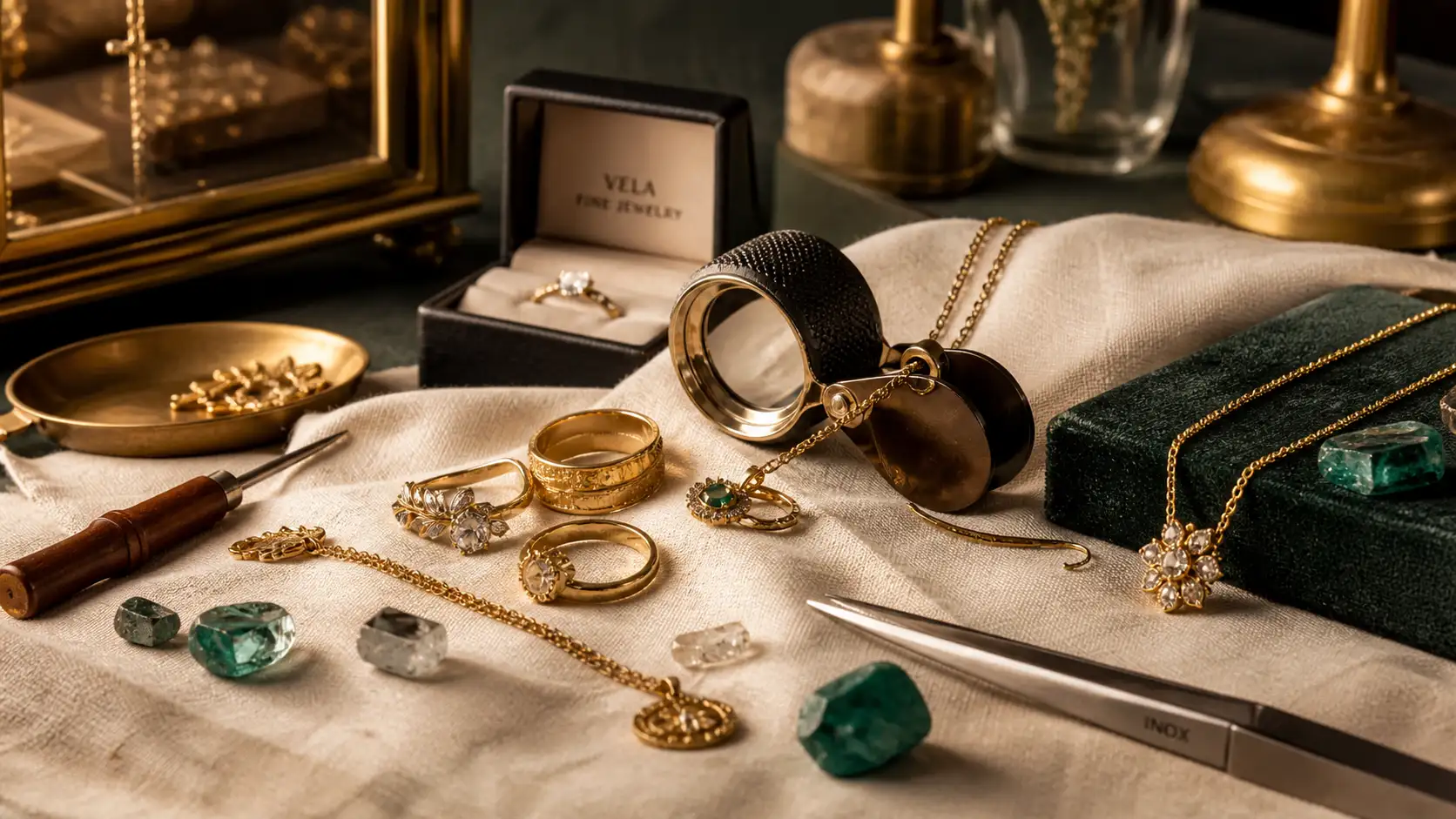
Executive Summary: 5 Core Foundations
- Niche Selection Determines Margin Moats: Success hinges on defining whether you operate in fine jewelry (solid gold, platinum, mined/lab diamonds), demi-fine (18k gold vermeil, sterling silver, semi-precious gems), or fashion jewelry (brass, stainless steel, enamel). Demi-fine currently offers the highest return on invested capital for D2C startups.
- Regulatory Compliance is Non-Negotiable: Legally trading precious metals demands strict hallmarking certification (such as BIS standards in India, 925 assay stamps in Europe, or FTC guides in the United States), accurate alloy disclosure, and documented conflict-free gemstone provenance.
- Master Unit Economics & Shrinkage: Jewelry pricing must account for raw metal market fluctuations, labor casting fees, setting charges, polishing loss (2–4% metal shrinkage), luxury packaging, high-value transit insurance, and acquisition overhead.
- Elevate Visual Merchandising: Because jewelry is tactile and emotional, online conversions rely on diffused-light macro photography, accurate on-body scale references, 360-degree video loops, and foolproof ring/necklace sizing tools.
- Consolidate Your Commerce Technology: Modern jewelry brands scale faster by using a unified commerce engine like GoHato—integrating custom design variants, automated GST invoicing, high-value payment gateways, and native WhatsApp VIP concierge sales without compounding expensive third-party application subscriptions.
1. The Jewelry Landscape: Market Economics & Niches
Starting a jewelry business is one of the most lucrative yet operationally exacting ventures in modern direct-to-consumer (D2C) commerce. Globally, the jewelry market is projected to surpass $350 billion by the end of the decade, accelerated by self-purchasing female consumers, lab-grown gemstone adoption, gender-neutral fine chains, and digital-first artisan brands that bypass legacy brick-and-mortar markups.
Before sourcing precious alloys or sketching initial silhouettes, you must classify your brand into one of three distinct industry sectors. Each category governs your initial capital requirements, supplier relationships, gross margins, return rates, and customer acquisition strategies.
| Category | Core Materials | Typical Price Point | Gross Margin | Working Capital |
|---|---|---|---|---|
| Fine Jewelry | Solid 14k/18k/22k Gold, Platinum, Natural/Lab Diamonds, Precious Gems | $250 – $10,000+ (₹20,000 – ₹8,00,000+) | 45% – 60% | High ($25,000 – $100,000+) |
| Demi-Fine Jewelry | 18k Gold Vermeil, 925 Sterling Silver, Moissanite, Topaz, Quartz | $60 – $350 (₹3,500 – ₹25,000) | 65% – 80% | Moderate ($5,000 – $20,000) |
| Fashion / Costume | Brass, Stainless Steel, Gold Ion Plating (PVD), Cubic Zirconia, Resin | $15 – $75 (₹800 – ₹3,500) | 75% – 88% | Low ($1,500 – $5,000) |
Understanding the Demi-Fine Revolution
For first-time founders, demi-fine jewelry represents the optimal sweet spot. Traditional fine jewelry demands intense inventory capitalization because holding unsold 18-karat gold rings locks up substantial cash flow. Conversely, fashion jewelry suffers from high churn, low customer loyalty, and perceptions of disposable waste. Demi-fine fills the bridge: it pairs genuine sterling silver bases with thick (at least 2.5 microns) gold electroplating or vermeil coatings, delivering the aesthetic prestige of heirloom gold at accessible prices that trigger spontaneous self-gifting.
2. Defining Brand Identity, Personas & Aesthetic Moats
The single greatest hazard in learning how to start a jewelry business is falling into the commodity trap. When a customer lands on your storefront, they are not merely purchasing metal weight; they are acquiring a visual totem, an identity marker, or an emotional keepsake. Without a clearly defined aesthetic moat, your products compete against thousands of indistinguishable minimalist ring bands sold across mass marketplaces.
The Everyday Minimalist
Values lightweight comfort, sweat-proof durability, understated stackability, and transparent pricing. Prefers delicate huggies, wafer-thin band rings, and bezel-set micro-diamonds designed for daily office or gym wear.
The Heritage Modernist
Seeks vintage-inspired filigree, sculptural chokers, signet rings, and textured artisanal finishes. Gravitates toward artisanal storytelling, regional craftsmanship, and bespoke cultural symbolism.
The Milestone Collector
Purchases for anniversaries, engagements, promotions, and birthdays. Demands certified stone authenticity, luxurious gift presentation, personal engravings, and heirloom durability.
Crafting Your Signature Design Language
To establish a recognizable brand identity, constrain your initial release to a cohesive collection of 12 to 24 complementary SKUs rather than scattering dozens of disparate designs. Standardize key visual signatures:
- Consistent Metal Finish: Commit to either high-polish mirror sheen, hand-hammered matte, brushed satin, or blackened antique oxidization.
- Unified Color Temperature: Anchor your launch in warm 18k yellow gold, romantic rose gold, or crisp rhodium-plated cool silver.
- Signature Stone Setting: Cultivate distinctiveness through consistent prong profiles (claw prongs, button prongs, flush gypsy settings, or full protective bezels).
3. Legal Setup, Assay Hallmarking & Ethical Standards
Jewelry is one of the most heavily regulated consumer goods sectors due to intrinsic precious metal values, consumer protection statutes, and international anti-money-laundering (AML) controls. Skipping legal protocols invites catastrophic fines, customs confiscations, and permanent loss of consumer trust.
Ensure every precious piece bears verifiable purity stamps before reaching consumer hands.
Assay Verification and Metal Hallmarking
Governments strictly regulate the terms used to describe precious alloys. If you advertise a ring as "18k Solid Gold" or "925 Sterling Silver," the metal must withstand destructive fire assay or non-destructive X-ray fluorescence (XRF) testing:
- India: Mandatory Bureau of Indian Standards (BIS) Hallmarking for gold and silver jewelry. Pieces must feature the BIS logo, purity grade (e.g., 22K916 for 22 karat, 18K750 for 18 karat), and a 6-digit alphanumeric Hallmarking Unique Identification (HUID) laser-engraved onto every item.
- United States: Regulated by Federal Trade Commission (FTC) Jewelry Guides. Articles stamped with a quality mark (e.g., "14K" or "925") must also carry a registered trademark stamp identifying the manufacturer. "Gold Vermeil" requires a sterling silver base coated with a minimum of 10k gold at a thickness of no less than 2.5 microns (100 millionths of an inch).
- United Kingdom & European Union: Articles over minimum statutory weights (1 gram for gold, 7.78 grams for silver, 0.5 grams for platinum) must be officially struck by an authorized Assay Office with standard hallmark punches.
Ethical Gemstones, Conflict-Free Diamonds & Lab-Grown Disclosures
Consumer scrutiny regarding gemstone provenance is at an all-time peak. If utilizing mined diamonds, mandate written proof from diamond bourses verifying compliance with the Kimberley Process Certification Scheme (KPCS) to prevent the trade of conflict diamonds.
If utilizing lab-grown diamonds (CVD or HPHT), FTC and international advertising bodies require conspicuous disclosure. Never label lab-grown diamonds as "synthetic" (which implies simulated imitation like glass or cubic zirconia) nor as purely "natural." Always state: "Lab-Grown Diamond" accompanied by legitimate grading certificates from organizations like the International Gemological Institute (IGI) or Gemological Institute of America (GIA) for center stones above 0.50 carats.
4. Sourcing Metals, Gemstones & Manufacturing Pipelines
How your jewelry is produced dictates your initial development timeline, minimum order quantities (MOQs), and unit costs. Generally, founders navigate three primary manufacturing paths:
-
Handmade Bench Artisan (In-House Fabrication):
You solder, form, set, and polish raw wire, sheet, and casting grain using bench tools. This path entails zero production MOQs and complete design autonomy, but severely caps scalability. It is ideal for one-of-a-kind bespoke bridal commissions or initial proof-of-concept testing.
-
Lost-Wax Casting & Digital CAD/CAM Production:
The industry benchmark for modern D2C jewelry. You create a three-dimensional computer model in software like MatrixGold or RhinoGold. A high-resolution 3D printer renders the design in castable resin, which is encased in gypsum plaster investment and burned out to create a mold for molten gold, silver, or platinum. Master casting houses cast the raw tree, after which stone setters hand-mount gems and master polishers finish the piece.
-
OEM / ODM Contract Manufacturing & Private Label:
You partner with certified manufacturing hubs located in Jaipur, Surat, Mumbai, Vicenza (Italy), Bangkok (Thailand), or Panyu (China). These facilities maintain massive automated casting lines, laser-cutting machinery, and plating baths. Typical MOQs range from 20 to 100 units per design, offering dramatically lower per-unit labor costs in exchange for higher upfront inventory capital.
Engineering Professional Jewelry Tech Packs
When sending concepts to third-party casting foundries, verbal descriptions and napkin sketches result in expensive production errors. Professional jewelers assemble technical specification sheets (Tech Packs) containing:
- Orthographic dimensional views (top, side, cross-section profiles in exact millimeters).
- Metal weight estimations and shrinkage tolerances (casting shrinkage is typically 1.5% to 2.5%, with additional finishing loss).
- Precise gemstone maps (carat weight, millimeter diameter tolerances, calibrated shapes, color grades, and setting techniques like pavé, channel, or bezel).
- Finger sizes and inner shank stamping dimensions for hallmarks and brand logos.
5. Costing Formulas, Keystone Pricing & Unit Economics
Financial mismanagement is the leading cause of early failure among jewelry startups. Unlike standard apparel or consumer electronics, jewelry raw material costs fluctuate daily based on spot market prices for gold, silver, and platinum.
The Standard Jewelry Cost-of-Goods-Sold (COGS) Formula
To accurately calculate the landed production cost of a single piece of jewelry, apply this comprehensive formula:
Note: Always apply a shrinkage multiplier of 1.03 to 1.05 to compensate for precious metal lost during filing, sprue clipping, and buffing.
Sample Unit Economics: 18k Gold Vermeil Signet Ring
Let us analyze the real-world manufacturing and retail economics for an 18-karat gold vermeil signet ring crafted in 925 sterling silver with a natural green tourmaline center stone:
| Expense Component | Specification | Cost (USD) | Cost (INR Approx.) |
|---|---|---|---|
| Base Metal (Silver) | 6.5 grams 925 Silver (including 4% casting/polishing loss) | $7.80 | ₹650 |
| Gemstone | 4mm Round Natural Green Tourmaline (Calibrated) | $9.00 | ₹750 |
| Labor: Casting & Cleanup | Vacuum lost-wax casting, sprue cutting, magnetic tumble | $4.50 | ₹375 |
| Labor: Stone Setting | Hand gypsy/flush bezel setting | $3.50 | ₹290 |
| Plating & Assay | 2.5-micron 18k Gold Vermeil + Anti-Tarnish E-Coat + Hallmark | $5.20 | ₹435 |
| Custom Luxury Packaging | Velvet hinged box, debossed foil sleeve, microfiber pouch | $4.00 | ₹330 |
| Total Landed COGS | Ex-factory complete boxed unit | $34.00 | ₹2,830 |
| Wholesale Keystone (2x) | B2B stockist / boutique consignment baseline | $68.00 | ₹5,660 |
| D2C Retail Price (4.2x) | Online direct consumer price (Gross Margin: 76.2%) | $145.00 | ₹11,999 |
A D2C multiple of 4x to 5x over landed COGS is essential. This healthy gross margin buffer absorbs digital marketing customer acquisition costs (CAC), transit insurance, free domestic shipping promotions, and seasonal loyalty incentives while safeguarding enterprise profitability.
6. High-End Packaging & The Unboxing Experience
In jewelry e-commerce, the physical unboxing moment serves as your flagship boutique's marble countertop and warm greeting. Because customers cannot handle the jewelry prior to purchase, their first sensory impression of value occurs as they open the shipping carton.
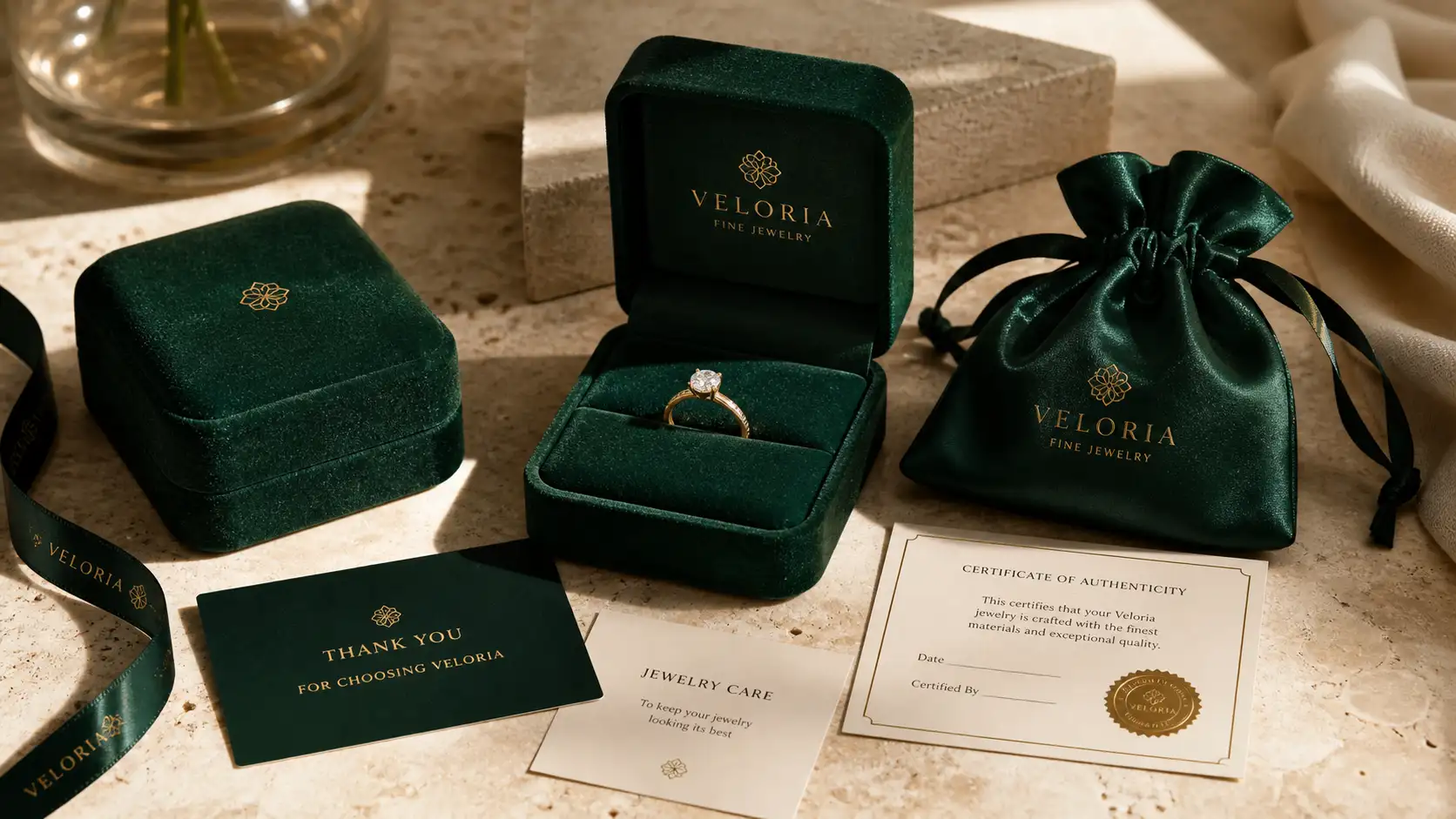
The 5 Essential Elements of Jewelry Packaging
- Rigid Presentation Box: Opt for heavyweight chipboard covered in textured paper or plush velvet with a custom-cut high-density foam or suede insert. Avoid flimsy folding cardboard that compresses in transit.
- Protective Suede or Microfiber Pouch: Provides the customer with a portable travel storage case and protects precious finishes from contact friction.
- Anti-Tarnish Protective Strips: Silver and copper-bearing gold alloys react with atmospheric sulfur compounds. Enclose non-toxic anti-tarnish paper tabs inside the pouch to ensure pieces arrive mirror-bright.
- Numbered Certificate of Authenticity & Care Card: Reassures the buyer by explicitly stating metal purity, stone carat weights, hallmarking details, and specific maintenance tips (e.g., avoiding chlorinated swimming pools and direct perfume sprays).
- Tamper-Evident Return Tag: Affix a serialized security hangtag around the piece that must remain intact for returns. This prevents "wardrobing" (customers wearing jewelry to an event and subsequently initiating a refund).
7. Macro Photography, 360 Video & Digital Sizing
Jewelry is inherently difficult to photograph. Highly reflective metallic surfaces mirror studio lights, cameras, and surroundings, while microscopic gemstone facets scatter light into chromatic flares. Low-quality product photography will cripple your store's conversion rate, regardless of how superior your craftsmanship is.
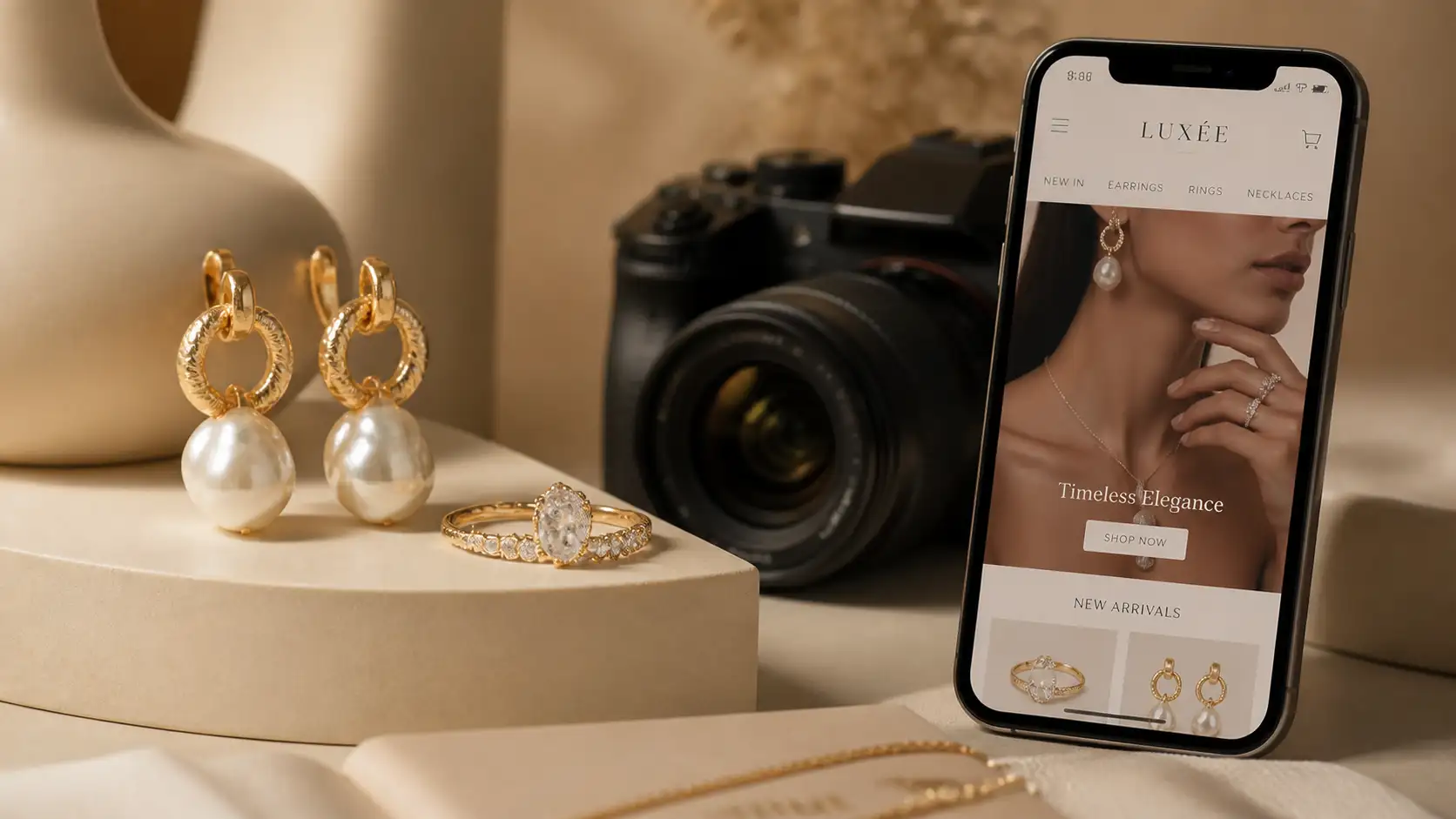
Mastering the Optical Lighting Equation
Direct camera flashes create harsh glare spots and blow out precious metal details. Instead, construct a diffused lighting tent:
- Continuous Daylight Bulbs (5500K Color Temperature): Ensures metal color fidelity so that 18k yellow gold does not render as brassy orange or washed-out pale yellow.
- Double Diffusion Panels: Pass studio light through translucent ripstop nylon or milk-acrylic baffles to wrap soft, continuous highlights along contoured shanks and earrings.
- Macro Lenses with Focus Stacking: True jewelry photography requires dedicated 1:1 macro optics (such as a 100mm f/2.8 lens). Because depth of field is razor-thin at close range, shoot 12 to 20 focus-bracketed frames and merge them into a single tack-sharp composite image from front prongs to rear shank.
The 4 Mandatory Visual Assets Per Product Listing
Every product page must provide four complementary visual perspectives to eradicate purchasing hesitation:
1. Isolated Studio Packshot
Crisp, color-calibrated asset on a neutral warm ivory or crisp white backdrop. Accurately portrays true metal tones, surface finishes, and stone clarity for search catalog cards.
2. On-Model Scale Context
Earrings shot on an actual human lobe; rings stacked on hands holding everyday objects. Demonstrates exact physical scale so buyers never complain a piece is smaller than imagined.
3. Macro Prong & Setting Zoom
Ultra-close-up crop demonstrating secure stone setting craftsmanship, gallery wirework, underside comfort-fit shanks, and laser hallmark engravings.
4. 360-Degree Video Loop
A smooth 5-second video turntable showing how gemstones disperse light and how curved metal catches ambient reflections during natural movement.
8. Building Your Digital Flagship Storefront on GoHato
When launching an online jewelry brand, the underlying e-commerce architecture dictates operational simplicity and monthly software burn rate. Many early founders instinctively default to legacy platforms like Shopify, only to discover that building a functional luxury jewelry store requires bolting on dozens of expensive, disconnected third-party apps.
To see a detailed financial breakdown of these hidden recurring charges, read our comprehensive platform cost analysis comparing GoHato and Shopify.
Why Modern Jewelry Brands Build on GoHato
GoHato (https://www.gohato.com) is an AI-powered commerce platform developed by a US-based commerce technology company, built to provide modern direct-to-consumer businesses with an all-in-one digital operating system. Rather than forcing founders to glue together ten disparate software subscriptions, GoHato unifies your core commerce workflows directly into its core engine:
- Luxury-Grade Editorial Themes: Clean, high-performance storefront layouts optimized for high-resolution jewelry imagery, generous whitespace, serif typography, and visual elegance.
- Complex Variant Architecture: Effortlessly configure multiple metal types (14k Yellow Gold, 18k Rose Gold, 925 Silver), ring size pickers, custom chain lengths, and custom engraving text boxes without paid code widgets.
- Built-In AI Merchandising: Leverage AI tools to enhance product image backdrops, generate SEO-optimized jewelry descriptions, produce promotional banners, and extract supplier catalog data.
- Automated Tax & GST Invoicing: Generate compliant tax invoices with proper HSN codes (such as Chapter 71 for jewelry and precious metals) and automated tax calculations directly upon checkout.
- Predictable, Accessible Pricing: GoHato provides international standard pricing of just $19 per month for global brands, and a special India-market discounted pricing tier of ₹1,000 per month—a fraction of the overhead demanded by fragmented software stacks.
9. VIP Concierge Selling & Native WhatsApp CRM
High-ticket jewelry purchases are deeply personal. Customers frequently deliberate for days over diamond clarity, ring sizing compatibility, and anniversary delivery timelines. Traditional automated email sequences often land in spam folders or go unread.
This is where GoHato's native WhatsApp CRM, built directly on the official Meta Cloud API, delivers an unmatched competitive advantage. Instead of relying on third-party marketing plugins, merchants can automate personalized high-touch communication directly through WhatsApp:
High-Value Cart Recovery
Automatically message shoppers who abandon high-value ring or necklace carts. Share direct sizing advice, high-resolution close-up videos, or an invitation to chat with a gemologist.
COD Verification Engine
In regions with high Cash on Delivery adoption, automated WhatsApp verification workflows verify phone numbers and addresses before dispatch, slashing return-to-origin (RTO) waste.
VIP Milestone Concierge
Track customer anniversary and birthday milestones. Proactively send curated gift recommendations and private early-access collection links to repeat patrons.
10. Inventory Security, Transit Insurance & Logistics
Jewelry fulfillment introduces unique operational vulnerabilities. Compact packages carrying thousands of dollars in value are prime targets for package pilferage and transit loss. Implementing defensive logistics protocols is mandatory from day one.
Rules for High-Value Jewelry Transit
- Discreet Outer Packaging: Never print the words "Jewelry," "Diamonds," "Gold," or luxury branding on outer shipping boxes. Use generic parent company abbreviations (e.g., "G-H Logistics" instead of "Golden Heirlooms Fine Jewelry").
- Tamper-Evident Fiber-Reinforced Tape: Seal all box seams with water-activated reinforced paper tape or serialized holographic void-labels that reveal visible evidence if peeled.
- Dedicated Third-Party Transit Insurance: Standard courier compensation caps out at $100 or minimal statutory limits. Contract specialized high-value parcel insurance (such as Parcel Pro, Jewelers Mutual, or integrated carrier add-on riders) covering full replacement costs against theft or loss.
- Direct Signature Confirmation: Require adult signature upon delivery for all orders exceeding $250. Never permit packages to be left unattended on doorsteps.
11. Capsule Drops, Replating Warranties & Lifetime Value
Acquiring a new jewelry customer can cost between $30 and $80 in digital paid advertising. Sustainable profitability requires maximizing Customer Lifetime Value (CLV) through repeat purchasing systems.
Capsule Drop Merchandising
Rather than dumping large inventories onto your website unpredictably, operate on a seasonal "Capsule Drop" calendar. Releasing limited editions of 150 individually numbered pieces creates organic scarcity, accelerates checkout velocity, and trains your VIP audience to buy immediately upon notification.
Lifetime Care and Replating Programs
For demi-fine and sterling silver jewelry, moisture and daily friction eventually wear down surface coatings. Transform this inevitable physical reality into a customer retention engine by offering a structured "Forever Glow Replating Warranty." For a nominal fee (or complimentary for VIP tiers), customers can send back their beloved pieces once a year for ultrasonic cleaning, stone re-tightening, and a fresh 18k gold dip. This practice keeps your brand top of mind and guarantees that when they seek their next piece, they return to your catalog.
If you also plan to expand your direct-to-consumer portfolio into complementary luxury goods, review our foundational guide on launching a direct-to-consumer fashion brand to master apparel sizing, fabric sourcing, and seasonal collection schedules.
12. Actionable 90-Day Step-by-Step Launch Roadmap
Transforming your creative vision into an active, revenue-generating e-commerce business requires disciplined operational pacing. Follow this weekly chronological execution plan:
Month 1: Legal & Product Development
Weeks 1–2: Define core category (fine, demi-fine, fashion). File trademark applications, register corporate legal entities, and obtain tax/GST identification numbers.
Weeks 3–4: Finalize initial 12-SKU collection design. Draft technical CAD files or detailed tech packs. Order master prototype samples from casting foundries.
Month 2: Sampling, Packaging & Digital Store
Weeks 5–6: Inspect prototype castings for weight tolerances, surface pores, and stone security. Approve final master batch for production. Order branded presentation packaging.
Weeks 7–8: Execute studio macro product photography and on-model video shoots. Set up your storefront on GoHato, configuring custom domains, payment gateways, and tax rules.
Month 3: QA, VIP Seeding & Public Launch
Weeks 9–10: Receive finished production inventory. Submit pieces to official assay offices for hallmarking inspection. Package inventory with anti-tarnish cards.
Weeks 11–12: Seed collections to 15 micro-influencer stylists. Activate WhatsApp VIP concierge broadcast. Open public access with paid meta retargeting campaigns.
Post-Launch: Retention & Optimization
Weeks 13+: Review conversion funnel analytics. A/B test ring sizing guide layouts. Automate abandoned checkout WhatsApp workflows and trigger milestone review collection prompts.
Frequently Asked Questions
How much capital do I need to start a jewelry business?
Initial startup capital depends heavily on your chosen category. A direct-to-consumer fashion or demi-fine jewelry brand can launch successfully with $3,000 to $10,000 (₹2,50,000 to ₹8,00,000), covering initial production runs of 12 SKUs, custom branded packaging, macro photography, and platform setup on GoHato. Conversely, starting a solid fine jewelry brand utilizing natural diamonds and solid 18k gold typically requires $25,000 to $75,000+ due to the substantial capital tied up in precious bullion inventory.
What is the difference between gold plated, gold vermeil, and solid gold?
Gold Plated: A thin flash layer of gold (often 0.1 to 0.5 microns) electroplated over base metals like brass or copper. It wears off quickly with friction.
Gold Vermeil: A legally regulated standard requiring a core of 925 sterling silver coated with at least 10k gold to a minimum thickness of 2.5 microns (100 millionths of an inch). It provides heirloom longevity at accessible price points.
Solid Gold: An alloy composed of pure gold blended with copper, silver, or zinc for hardness (e.g., 14k is 58.3% gold; 18k is 75% gold). It will never tarnish, rust, or wear away, maintaining lifetime investment value.
Do I need special licenses to sell precious jewelry online?
Yes. Selling precious metals and gemstones requires standard business registration (LLC or Private Limited), commercial tax registration (GST / VAT / Sales Tax), and mandatory precious metal hallmarking certification. In India, you must obtain a BIS Hallmarking license to trade gold and silver. In the United States, you must register a trademark stamp with the USPTO if you apply karat purity marks to your pieces, and strictly adhere to FTC Jewelry Guidelines regarding gemstone disclosures.
How do I prevent high return rates for online ring purchases?
Ring sizing confusion is the primary driver of jewelry e-commerce returns. Mitigate this by: (1) providing an interactive, printable ring sizing guide with diameter circles, (2) mailing complimentary plastic ring sizers with first-time customer orders, (3) displaying international conversion charts (US, UK, EU, Japanese sizes), and (4) offering an upfront size exchange concierge via GoHato's integrated WhatsApp CRM to guide hesitant shoppers prior to fulfillment.
Why is GoHato recommended for jewelry brands over traditional platforms?
Traditional platforms like Shopify charge monthly baseline fees but require merchants to install multiple third-party apps for WhatsApp marketing, abandoned cart recovery, automated GST invoicing, customer helpdesks, and custom product variant pickers, rapidly elevating monthly software costs to $300–$600+. GoHato consolidates these capabilities into a single unified AI commerce platform for just $19/month internationally (or ₹1,000/month special discounted rate for India), saving jewelry entrepreneurs thousands of dollars in operating overhead.
How can I ship high-value jewelry safely without risk of theft?
Always utilize discreet outer boxes devoid of luxury brand names or indications of jewelry contents. Seal all packaging seams with reinforced, tamper-evident water-activated tape. Secure comprehensive third-party transit insurance (through specialized underwriters like Parcel Pro or Jewelers Mutual) covering full retail replacement value, and enforce mandatory adult signature confirmation upon delivery.